Where Mass Is, Time Slows — and Now We Know Why
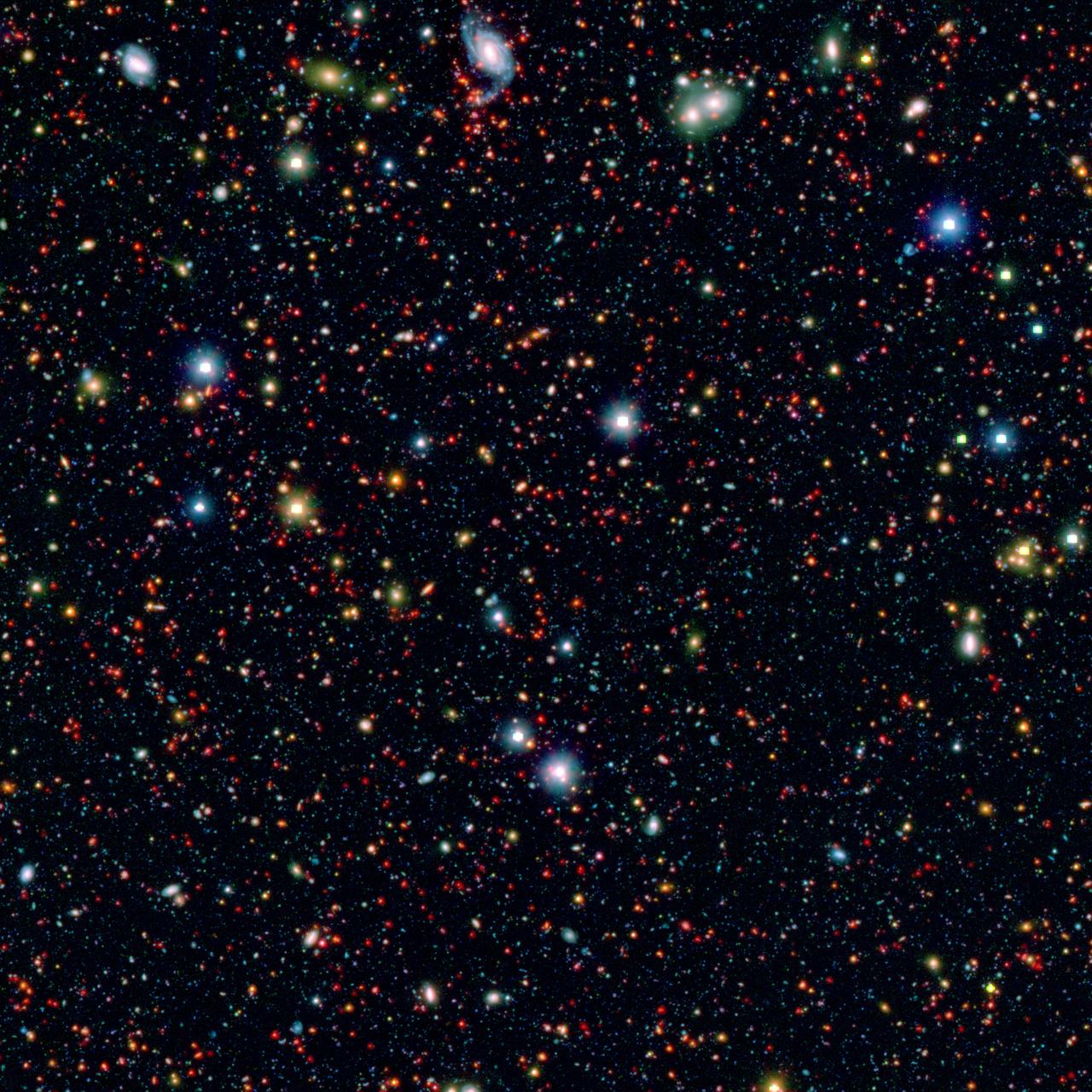
Image credit: NASA/JPL-Caltech (Millions of galaxies populate the patch of sky known as the COSMOS field, short for Cosmic Evolution Survey)
Where Mass Is, Time Slows — and Now We Know Why
Five results that Newton and General Relativity never explained, derived from a single sentence.
Einstein told us that clocks run slower near a massive object. GPS satellites have to correct for this every day — without the correction, your navigation would drift by kilometres within hours. The mathematics of General Relativity predicts the effect precisely. But GR does not explain, in plain physical terms, why mass slows time.
This post presents a derivation of gravitational time dilation — and four other results — from the single principle introduced in the earlier posts in this series:
Everything seeks to expand as freely as possible.
No new particles, no new forces, no adjustable constants.
0. One equation, everything in it
The core equation of this framework (established in v6.1 and v6.2):
The first term is how fast space itself is expanding at distance r
from a mass. The second is how much that expansion is being
suppressed by the mass — the expansion deficit.
What is left over is how fast everything actually moves.
Before going further, one observation: in a universe with no mass at
all, only the first term exists. Every point in space is then
equivalent to every other — there is no landmark, and the very
concept of "distance r" is meaningless. The moment a mass
M appears, two things happen simultaneously: an expansion
deficit is created, and "distance from M" becomes
a well-defined quantity. Mass does not sit at a pre-existing location;
it is what makes location meaningful in the first place.
1. One inequality classifies all motion
Newtonian mechanics treats bound orbits, inertial motion, and
escape trajectories as three different topics. In this framework,
they are the same equation, sorted by the sign of
a_matter(r):
| Condition | Sign of amatter | Result |
|---|---|---|
| GM/Aeff > H²r | Negative (−) | Bound — orbital motion |
| GM/Aeff = H²r | Zero | Inertial motion (rbalance) |
| GM/Aeff < H²r | Positive (+) | Recession — joins Hubble flow |
The most striking consequence: inertial motion is not a
third category. It is the single point where the expansion
deficit exactly cancels the expansion rate. Newton's first law —
"objects in motion stay in motion" — is the special case where
a_matter = 0 exactly. It is a boundary between two
regimes, not a regime in its own right.
2. Kepler's second law is conservation of expansion freedom
Kepler observed that a planet sweeps equal areas in equal times. Newton showed this follows from conservation of angular momentum. But neither explained what angular momentum is in physical terms.
In this framework:
r²is the area of suppression — how strongly radial expansion freedom is being withheld at that distance.v²is the expressed freedom — the freedom that has been redirected into tangential motion.
Freedom suppressed in the radial direction reappears as freedom expressed in the tangential direction. When a planet swings close to the Sun (small
r), its radial freedom is more strongly
suppressed — and it moves faster to compensate. When it is far away,
the suppression is weaker, and it moves more slowly. The product
r²v² stays constant throughout.
The familiar relation GM = rv² (for a circular orbit) is
a special case of this, when r is constant. For an
elliptical orbit, only r²v² is conserved; rv²
varies. The well-known result is therefore the circular shadow of the
more general conservation law.
3. The galaxy's edge is a survivor, not a boundary
In v6.2 we introduced the natural boundary
rbalance = (GM/H²)^(1/3) — the radius where
the expansion deficit exactly equals the expansion rate, verified at
the solar system's outer edge (Oort Cloud, ~1 pc) and the Milky Way's
outer edge (~200 kpc).
A subtler point: rbalance is not a cause. It
does not reach out and hold stars at a fixed distance. It is a
result of the dynamics:
- Matter that was originally beyond
rbalancehada_matter > 0— it accelerated outward and is now part of the Hubble flow. It is gone. - Matter that was originally inside fell further inward.
- Only matter near
rbalanceremains, in circular inertial motion.
The stars we observe at a galaxy's outskirts are the survivors of this sorting process — not a population placed there by a boundary condition. The edge of a galaxy is more like a coastline (where sediment neither washes away nor accumulates indefinitely) than a wall.
4. Time dilation, derived
This is the result I am most pleased with. Here is how to go from the expansion deficit to gravitational time dilation, step by step.
Step 1: local deficit
GM/r² is the expansion deficit at one point — an
acceleration, measuring how strongly expansion is suppressed
right here.
Step 2: accumulated deficit
Time dilation depends not on the deficit at one point, but on the deficit accumulated along the entire path from far away (where expansion is unsuppressed) to here. Multiplying an acceleration by a distance gives an accumulated quantity:
Φ(r) is the familiar gravitational potential, now read
as the total expansion deficit accumulated en route to
r.
Step 3: fraction of the universal rate
Φ(r) has units of (velocity)², the same units as
c². Dividing gives a dimensionless number:
This is the fraction of the universe's maximum rate of change that
has been used up by accumulated expansion deficit at r.
Step 4: from deficit to time
Time is the measure of change. If a fraction δ(r) of the
universal rate of change has been spent on suppressing expansion at
r, only the remainder is available for ordinary change —
including the ticking of clocks.
This is exactly the General-Relativistic weak-field time dilation formula — derived here without spacetime curvature, without the metric tensor, without any adjustable constant.
Numerical verification
| δ(r) = GM/(rc²) | |
|---|---|
| Earth's surface | 6.951 × 10⁻¹⁰ |
| GPS orbital altitude | 1.667 × 10⁻¹⁰ |
| Difference | 5.284 × 10⁻¹⁰ |
| GR prediction (same quantity) | 5.284 × 10⁻¹⁰ |
| Ratio | 1.0000 |
Where mass is, expansion is suppressed. Both space and time share this suppression — space because the expansion deficit directly reduces
a_matter(r), time because the accumulated
deficit Φ(r)/c² is subtracted from the universal rate
of change. No separate mechanism is needed to link the two effects.
They are two readings of the same number.
5. Why dark matter and dark energy were inevitable — in GR
General Relativity made a genuine revolution: it removed the Newtonian force of gravity. But it kept something force-like: a three-step causal structure.
This structure — cause, intermediary, effect — is the skeleton of any force theory, even if the intermediary is now "curvature" rather than "force field." When observation and prediction disagree, there are exactly two options within this structure:
- Add more cause (unobserved mass) to make the mediator bigger. → Dark matter.
- Add a correction term to the mediator equation itself. → Dark energy (cosmological constant).
Neither option is arbitrary: once you accept the three-step structure, and once there is a mismatch, you must add something somewhere. Dark matter and dark energy are not exotic speculation; they are the logically necessary patch for a framework that describes motion through a mediator.
Mass is not a cause that produces an intermediate field which in turn causes motion. Mass is a record — the measure of how much a region's expansion has been suppressed by binding forces. Motion follows directly from the equation
a_matter = H²r − GM/A_eff, with no intermediate object
whose magnitude could be "too small" or "too large."
When the geometry of the system is described correctly (using the right
A_eff for disks, filaments, or clusters, as in v6.2),
the motion matches the observation. There is nothing to patch.
This is one level deeper than the Mercator-map analogy of v6.2. The Mercator analogy explains that standard cosmology distorts. This explains why the distortion was filled with new substances — because patching a mediator-based theory is the only move available inside that theory.
6. "Everything" means everything — including light
The axiom says everything seeks to expand as freely as possible. Does that include photons?
A photon has no binding force and represents complete, unsuppressed
expansion freedom. Radiation pressure — the outward push of photons
streaming from a star — is that freedom acting on matter. At stellar
scales, where the cosmological expansion term H²r is
negligible, the balance condition takes a familiar form:
This is the Eddington luminosity limit: the point at which a star's
own radiation pressure exactly balances its expansion deficit. Solving
for L gives the standard Eddington luminosity formula —
rederived here as the same a_eff = 0 balance that gives
rbalance at galactic scales, with radiation
pressure in the role that H²r plays for galaxies.
| Cosmological scale | Stellar scale | |
|---|---|---|
| Outflow term | H²r (residual Big Bang expansion) | arad (fusion-generated radiation) |
| Deficit term | GM/Aeff(r) | GM/r² |
| Balance = 0 gives | rbalance (galaxy edge, Oort Cloud) | LEdd (maximum star luminosity) |
The word "everything" in the axiom is not rhetorical.
What is still open
This framework makes contact with two well-tested results (Kepler's second law, gravitational time dilation) without new assumptions, and it offers a structural diagnosis of why dark matter and dark energy became necessary. What it does not yet do:
- Derive the characteristic scale of large-scale structure (~150 Mpc) from first principles. This is in progress.
- Explain the origin of binding forces. These are taken as given, as in v6.0–v6.2.
v6.3 preprint: https://zenodo.org/records/20703636
v6.2: The Expansion Freedom Principle v6.2
v6.1: The Expansion Freedom Principle v6.1
v6.0: The Expansion Freedom Principle v6.0
v4.0: Gravitational Flux Transport Networks v4.0


Comments
Post a Comment