Not Just Mass: Expanding Space Also Curves Light
Not Just Mass:
Expanding Space Also Curves Light
Why dark matter appears at large scales, why spiral arms wind the wrong way for a trailing structure, and why the standard rotation-curve measurement has a systematic problem — all from one principle.
Expanding space (H²r) curves light and contributes to orbital speeds — not mass alone. Anything that expands toward a passing body curves its path. Mass expands (GM/Aeff); space itself expands (H²r). Both bend light. Both drive orbits. Dark matter is the residual produced when the H²r contribution is omitted.
Why we never noticed space was expanding
Imagine the simplest possible universe: the Sun expands at rate GM/r², visible and growing larger every day. Mercury drifts away as both bodies swell. Nothing behaves the way we actually observe.
This is not what happens, because we are inside an expanding background — the same background as everything else. The observer, the ruler, the clock, and Mercury are all embedded in aspace = H²r + GM/r². A background shared by everything is invisible. Only deviations from it can be seen. The deviation of matter from space is 2GM/Aeff. That deviation — and only that — is what Newton called gravity.
This also explains why Einstein chose Minkowski (static) spacetime: not because space is truly static, but because the expanding background is invisible to observers within it. EFT makes the invisible background explicit, identifying it as de Sitter spacetime.
Four effects that determine every orbit
When a mass expands toward a passing body, four effects act simultaneously. Together, they are the complete physics of expansion rotation.
The Sun's expanding surface moves toward Mercury at GM/r². This curves Mercury's path inward. Alone, it would send Mercury into the Sun.
Mercury moves sideways at speed vt. When effects 1 and 2 balance — GM/r² = vt²/r — a stable orbit results. Mercury is not pulled. Its straight path is curved by the approaching face. The tangential motion prevents it from falling. This balance is expansion rotation.
A moving body also sees the lateral (flattening) surface of the expanding mass. How much depends on both the speed vt and the size r of the mass:
Mercury and the Sun: Mercury moves at 48 km/s — slow by cosmic standards. But the Sun is small. Mercury reaches the lateral position in roughly 4 hours. It samples the flattening surface. The curvature correction κ = 1 + 3vt²/c² is slightly above 1, and over 415 orbits per century this accumulates to exactly 43 arcseconds of perihelion advance.
An outer-disk star and its galaxy: The star moves at 200 km/s — much faster than Mercury. But the galaxy is 10¹⁷ times larger. To reach the lateral position, the star would need longer than the age of the universe. From the galaxy's reference frame, the star is effectively stationary. It sees only the approaching face. κ ≈ 1. No closed orbit forms. The star falls inward in a slow spiral — not a rotation.
Light: vt = c, κ = 4. Deflection = 4GM/bc². Newton's calculation (κ = 1) gives half this value. The factor of 2 discrepancy is entirely explained by effect 3.
Imagine a circular protractor the size of the Sun, expanding at exactly aspace. The Sun also expands at approximately aspace. Relative to this protractor, the Sun's size does not change — size information is washed out. What survives is only the angle: the Sun expands non-uniformly (stronger toward Mercury by GM/r²), so the angular deviation is observable. Scale vanishes; direction survives. This angular residual is the sole agent that curves Mercury's path.
The H²r contribution that dark matter has been hiding
At solar-system scales, the conformal effect leaves only GM/r². Newton is exact. But at galactic and cluster scales, the spatial expansion term H²r is no longer negligible. It contributes independently to the survival speed of an orbit:
v²(r) = GM·r / Aeff(r) + H²r²
The first term (Aeff geometry) produces the flat rotation curve. The second term (H²r²) produces the outer velocity rise. MOND has no H²r² term and cannot produce the outer rise structurally. Dark matter halos are tuned after the fact. EFT predicts both with zero free parameters — H is measured independently.
The same principle applies to gravitational lensing. When light passes through a galaxy cluster, three contributions bend it: the baryonic mass (4GM/bc²), the path-length accumulation over megaparsecs, and the direct contribution of the space expansion H²r. The cluster is enormous; the photon is deflected continuously for millions of light-years. The inferred dark matter fraction scales as H²r³/GM — the same parameter-free scaling from both rotation curves and lensing.
Infall trajectories, not trailing structures
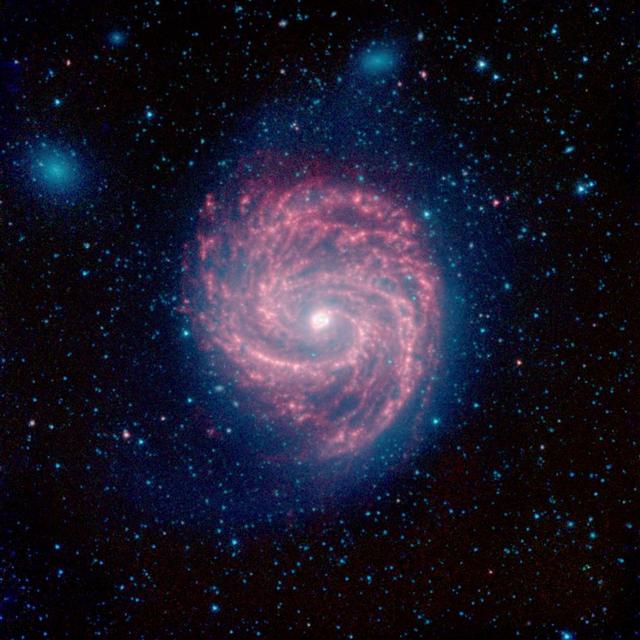
Standard lore holds that spiral arms are "trailing" — bent opposite to the rotation direction by differential rotation. The expansion-rotation model predicts the opposite, and observation confirms it.
Outer-disk stars are in slow spiral infall: they fall toward the galactic centre because κ ≈ 1 (effectively stationary in the galaxy frame, seeing only the approaching face). The tangential velocity winds this infall into a spiral. The spiral winds in the same direction as the rotation — not opposite. A trailing arm would wind the other way.
The apparent "trailing" impression is a parallax artefact. Inner stars orbit faster (small r, high v) and advance ahead of outer stars. The arm appears to lag — exactly as a slow train appears to move backward when viewed from a fast train. Both move forward; only the speed differs.
This also means that standard rotation-curve measurements — which assume circular orbits and set the infall velocity vr = 0 — absorb a systematic blueshift excess on the approaching arm. The true rotation speed is slightly lower than measured. Dark matter budgets are therefore overestimated. The size of the overestimate scales with the pitch angle of the spiral, a testable prediction.
EFT vs MOND vs dark matter
| Feature | Dark matter | MOND | EFT |
|---|---|---|---|
| Flat rotation curve | ✓ halo | ✓ | ✓ Aeff |
| Outer velocity rise | △ tuning | ✗ | ✓ H²r² |
| Cluster mass deficit | ✓ halo | ✗ | ✓ H²r² |
| Gravitational lensing excess | ✓ halo | ✗ | ✓ 3 contributions |
| Bullet Cluster offset | ✓ collision | ✗ | ✓ stellar + H²r |
| Dark matter ∝ r³ scaling | unexplained | unexplained | ✓ H²r³/GM |
| Spiral arm direction | trailing assumed | trailing assumed | ✓ infall direction |
| Physical mechanism | ✗ | ✗ | ✓ expansion |
| Free parameters | many | 1 (a₀) | 0 |
| GR limit | ✓ | ✗ | ✓ |
Two expansions. That is all.
Gravity has never been a force of attraction. It is the lag of matter behind expanding space — the deviation that remains visible when the expanding background cancels out. At small scales the lag is everything and the background is invisible; Newton is exact. At large scales the background itself contributes to orbital speeds and light deflection. Omitting it produces a deficit. That deficit has been called dark matter for fifty years.
The Expansion Freedom Theory does not contradict General Relativity. GR is recovered exactly in the H²r → 0 limit — the static-background snapshot of a dynamical expansion process. EFT makes the background explicit and extends GR to the scales where the background can no longer be ignored.
Space expands. Matter lags. The lag is gravity.
Space also curves light. The curvature is not all from mass.
What was called dark matter is the expansion of space, misread.


Comments
Post a Comment