Why Did the Spiral Arms of Galaxies Form?
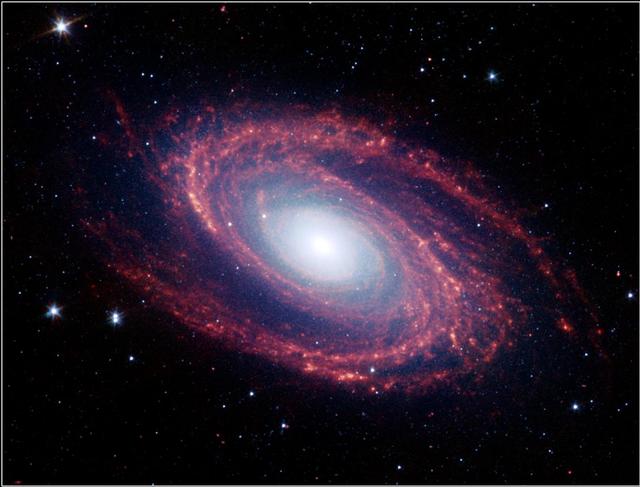
Why Did the Spiral Arms of Galaxies Form?
Every stable orbit has a ceiling — and it's lower than the point where orbits stop existing altogether. That instability boundary, not some mysterious force, is where the spiral begins.
Our own solar system almost certainly had spiral arms once. In the early, crowded disk of gas and debris around the young Sun, countless small bodies moved on paths that were not yet clean ellipses — some drifted inward and were consumed, some were flung outward and lost, and a very particular subset survived: the ones whose speed happened to match a stable orbit at their distance. What we call "the solar system" today is really the surviving population of that filtering process. The planets are the bodies that found the one speed, at their radius, that neither falls in nor drifts away.
Spiral galaxies show us that filtering process still in progress, on a much larger scale, and — this is the central claim of this post — with a boundary beyond which no filtering can succeed at all. Past that boundary, no orbital speed is stable. Everything there is transitional by necessity, not by accident. That is what a spiral arm is.
Three existing explanations
What mainstream astrophysics already offers
Before proposing anything new, it's worth being fair to the standard picture. Three explanations are commonly offered for spiral structure, and each captures something real.
| Model | Core idea | What it explains well |
|---|---|---|
| Density wave theory | Spiral arms are a slow-moving pressure wave; stars pass through it like cars through a traffic jam. | Why arms don't wind up and disappear after a few rotations. |
| Stochastic self-propagating star formation (SSPSF) | Star formation in one region triggers star formation in neighboring regions, sheared into arm-like chains by differential rotation. | Patchy, flocculent (non-grand-design) spiral structure. |
| Bar / tidal interaction | A central bar or a close companion galaxy gravitationally organizes gas into arms. | Grand-design two-armed spirals, especially barred galaxies. |
These models describe how existing material gets organized into an arm-shaped pattern. What they don't directly address is a more basic question: why should the outer disk of a galaxy be dynamically unsettled in the first place, rather than sitting in ordinary, quiet, closed orbits like the planets of the solar system? That is the question this post tries to answer from first principles.
The starting point
Two ways to describe the same expansion
The Expansion Freedom Theory (EFT) starts from one physical fact: space expands faster than matter. Matter, held together by binding forces, lags behind. This single fact can be written from two reference frames.
a_matter(r) = H²r − GM / A_eff(r) (test object's frame — assuming the object itself does not expand)
These are not interchangeable formulas — they differ by the fixed quantity 2GM/A_eff at every radius, so picking one over the other is not just a labeling choice. It comes down to which physical question is being asked. a_space describes the mechanism from the mass's side: how fast the sun expands toward Mercury. Orbital motion, though, is a question about the orbiting body — what centripetal acceleration does this star need to hold its path? That is a_matter's question: the net acceleration an ordinary, non-expanding body actually experiences. So the orbital condition below is built from a_matter, not a_space.
Corrected derivation
Why a circular orbit cannot exist beyond a certain radius
A star can only sit in a stable circular orbit if there is a net inward acceleration to supply the centripetal acceleration v²/r. Looking at a_matter, the inward-pointing piece is GM/A_eff, and the outward-pointing piece is H²r. The net inward acceleration is therefore the positive quantity:
This is the one change that matters: the orbital condition must be built from the net inward piece of a_matter, not from a_matter's raw signed value. Get this sign wrong and the resulting velocity becomes imaginary near the galactic center — an unphysical result that immediately signals a mistake in the setup, not a real prediction about the galaxy.
For a disk-shaped galaxy, the effective flux area scales as A_eff = 4πh·r, where h is an effective disk thickness — a purely geometric quantity, not to be confused with the Hubble constant H itself. Substituting:
v² = GM / (4πh) − H²r²
This expression is well-behaved everywhere it needs to be. Near the center (small r), v² approaches the finite, positive value GM/(4πh) — no imaginary velocities, no contradiction with the solid-body rotation observed in real galactic bulges. As r grows, the H²r² term grows with it, and v² steadily shrinks.
The critical radius
Where stable orbits run out
Set v² = 0 to find the radius at which the inward and outward accelerations exactly cancel — the radius beyond which no stable circular orbit can exist at all:
r_c = √( GM / (4πh·H²) )
This is the disk analogue of the balance radius r_balance already established for spherical systems (r_balance = (GM/H²)^(1/3) for A_eff = 4πr²) — the same idea, worked out for the flatter geometry of a galactic disk instead of a sphere.
Net acceleration is inward. A real, positive orbital speed exists at every radius. This is the ordinary disk of the galaxy — bulge and inner disk, behaving much like the solar system.
The net acceleration has flipped outward. There is no positive real solution for a circular orbit. "Orbital speed" stops being a meaningful concept — matter here does not circle, it is carried outward with the general expansion of space.
A sharper boundary
Orbits can exist and still not be stable
r_c only asks whether an orbital speed exists at all — it doesn't ask whether that orbit can actually hold. Those are different questions, and answering the second one moves the real boundary inward.
Building the full effective potential for a star with angular momentum L, using the same GM/A_eff and H²r terms as above, produces a curve shaped like a hill: a barrier near the center (stopping any star from falling all the way in), and a long downward slope at large r (the Hubble flow, falling away to negative infinity). Sitting between them is one true valley — a genuinely stable orbit — followed by one ridge, an unstable balance point beyond which nothing holds. Checking exactly where that ridge sits, by testing the curvature of the potential rather than just its value, gives a new radius:
Between r_s and r_c, something counterintuitive happens: v² is still positive — a naive plot of orbital speed looks perfectly ordinary there — but the orbit it describes sits on the ridge, not in the valley. The slightest nudge (and the Hubble expansion supplies a continuous one, everywhere, for free) is enough to tip it off. So the real onset of instability isn't r_c, it's r_s, noticeably further in — about 71% of the way out to r_c, not 100%.
This same two-boundary shape — an outer edge where orbits stop existing altogether, and a smaller inner radius where orbits still exist on paper but are already unstable — is a familiar structure in general relativity. It's the same pattern as the innermost stable circular orbit around a black hole, just flipped: there, strong gravity destabilizes orbits that get too close to the center; here, cosmic expansion destabilizes orbits that get too far from it.
Why a boundary produces a spiral, not a stop
Zero margin, not zero motion
A circular orbit anywhere between r_s and r_c is sitting on that ridge — mathematically balanced, but not actually held. Ambient Hubble expansion supplies a continuous, gentle outward nudge everywhere. Inside r_s, that nudge is trivial: the valley's walls absorb it and pull the orbit back. From r_s outward, there's no valley left to fall back into — the nudge is never undone, and the circular path can't be recovered. But the star doesn't simply fall away, either — there is still a small residual inward pull tugging it back toward the valley. What's left is neither a closed orbit nor a straight fall: a slow, continuous inward drift, wound by the disk's ongoing rotation into a spiral. The star is, in a real sense, falling on space rather than onto any fixed floor — the floor itself keeps receding outward as the star approaches, so the fall never completes. That slow winding fall, starting around r_s and continuing out toward r_c, is what a spiral arm is.
Putting it together
The spiral is what a boundary looks like from the inside
This is where the solar-system analogy from the opening comes back. Deep inside r_s, the galaxy is quiet: stars settle into stable, nearly circular paths, just like the planets did once the early solar system finished sorting its survivors from its losses. But r_s is not infinitely far out — it is set by ordinary numbers (the galaxy's mass, its disk thickness, and H²), and real disk galaxies extend well past it.
Material out there cannot do what the inner disk does. It cannot hold a closed circular path, because past r_s any such path sits on an unstable ridge rather than in a stable valley. What it can do is the slow winding drift described above — combined with the disk's overall rotation, that inward drift traces out a spiral rather than a circle or a straight fall. The arm is not a structure imposed on the disk from outside. It is the visible signature of matter that is geometrically forbidden from doing anything else.
In this picture, the three mainstream models are not wrong so much as incomplete: density waves, star-formation chains, and bars can all shape the fine detail of where the spiral pattern brightens or how tightly it winds, but the underlying reason the outer disk is available to be organized into a spiral in the first place is that it sits beyond r_s, where a settled circular orbit stops being a stable option — well before r_c, where it stops being possible at all.


Comments
Post a Comment